South African Solar Knowledge Hub & Engineering Guides
Unbiased, authoritative guides designed to help South African homeowners and businesses navigate Eskom tariffs, municipal SSEG bylaws, insurance CoC compliance, and inverter hardware selection.
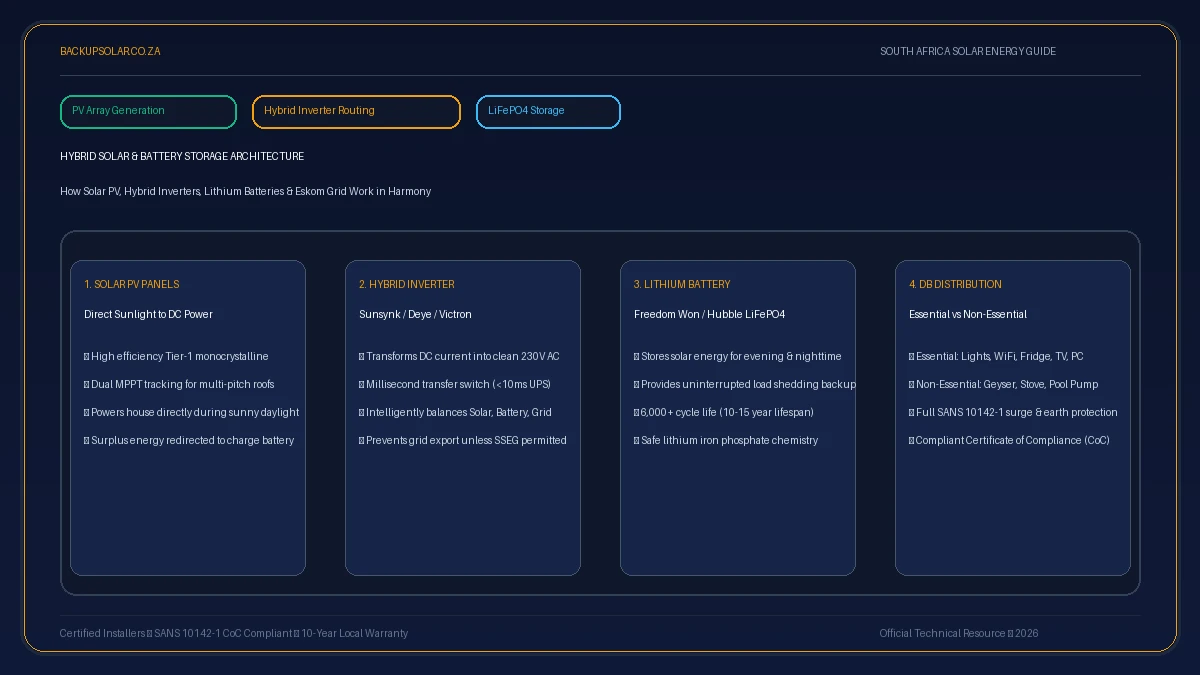
Featured Solar Authority Guides & Technical Research
Eskom 2026 Tariff Hikes & Financial Payback Analysis
Detailed breakdown of NERSA-approved electricity tariff increases, retail structural restructuring, and how solar LCOE at R0.82/kWh shortens system payback to under 3.5 years.
SANS 10142-1-2 Certificate of Compliance (CoC) Checklist
Mandatory 10-point inspection protocol for solar installations. Why insurers reject claims without registered DOL wireman sign-off and earth-neutral bonding relays.
Sunsynk vs Deye vs Victron: 2026 Hybrid Inverter Shootout
Direct engineering comparison of South Africa's top 3 hybrid inverters: efficiency, app monitoring (Sunsynk Connect vs VRM), surge capacity, warranties, and parallel scaling.
5kWh vs 10kWh Battery Runtime Matrix (Stage 4 & 6)
Real-world discharge runtime tables for Freedom Won, Hubble, and Dyness LiFePO4 batteries under 350W essential, 850W typical, and 2,200W heavy household power loads.
Essential Solar Concepts for South African Homeowners
Transitioning from Eskom grid dependence to self-sufficient solar power involves several key technical considerations unique to the South African regulatory environment:
1. The 10-Millisecond Transfer Switch
When load shedding hits, true hybrid inverters switch to battery power within 8 to 10 milliseconds. This ensures sensitive electronics (desktops, Wi-Fi routers, TV decoders) experience zero reset or data loss.
2. Essential Circuit DB Splitting
Your home's electrical panel is separated into essential circuits (backed up 24/7 by battery) and heavy non-essential loads (geyser, stove, oven, pool) that draw solar only when daylight is abundant.
3. Reverse-Power CT Clamp Limiting
A Current Transformer (CT) clamp monitors real-time consumption at your incoming municipal breaker and throttles solar generation to prevent prepaid meters from tripping or triggering tamper fines.
4. LiFePO4 Chemistry & 6,000 Cycles
Modern solar installations utilize Lithium Iron Phosphate (LiFePO4) cells rated for 6,000+ full charge/discharge cycles at 90% Depth of Discharge (DoD), delivering 15+ years of daily cycling life.