SANS 10142-1-2 Certificate of Compliance (CoC) Solar Checklist
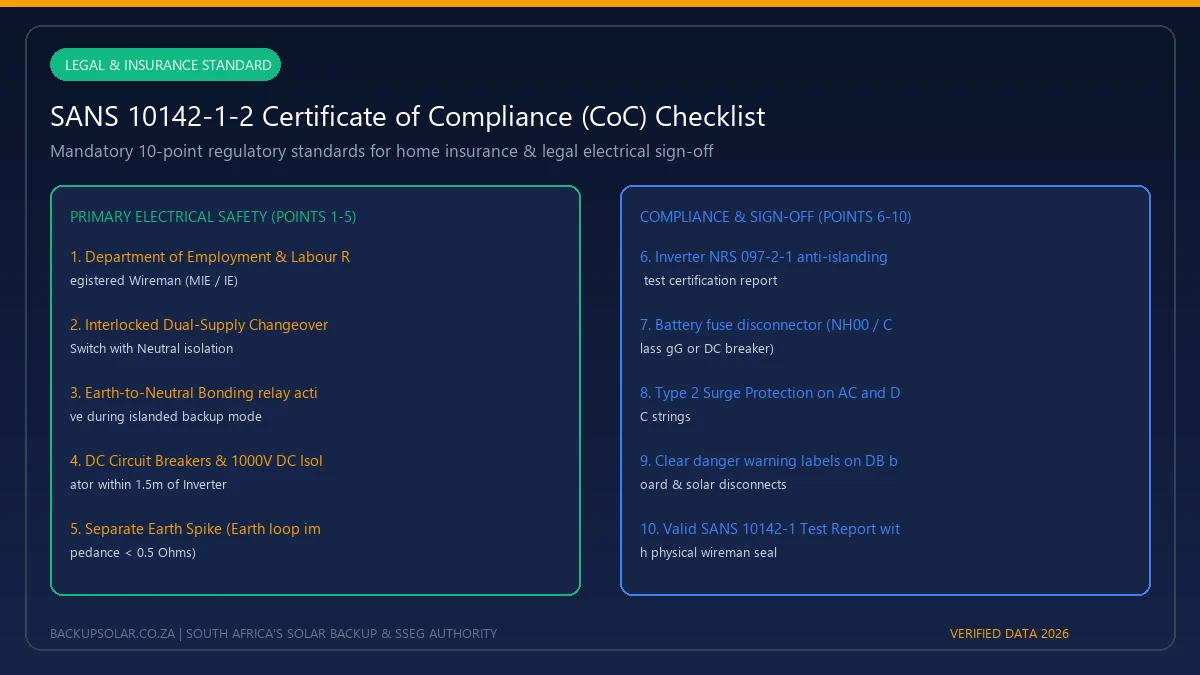
Installing a solar backup system transforms your residential property into a localized electrical power generation plant. Under South African law, you cannot legally operate or insure an embedded solar installation without an authentic Certificate of Compliance (CoC). Here is the comprehensive 10-point checklist every homeowner must verify before making final payment.
Why a SANS CoC is Legally Mandatory for South African Solar
Under the Occupational Health and Safety Act (Act 85 of 1993) and the Electrical Installation Regulations (EIR), any modification to a property's electrical distribution board requires an amended Certificate of Compliance. When solar panels, a hybrid inverter, and lithium batteries are integrated into your home's circuits, a specialized supplementary test report covering Section 7 (Embedded Generation) is legally mandatory.
Operating an uncertified solar system exposes property owners to criminal liability if an electrical fault causes injury, shock, or death to occupants, utility technicians working on municipal power lines, or neighbours.
The Home Insurance Danger: Uncertified Solar Claims Repudiation
The single greatest financial hazard facing homeowners who hire unregistered "bakkie brigade" installers is insurance repudiation. Every domestic homeowner's building and contents insurance policy contains an explicit warranty requiring all electrical fixtures to comply with SANS standards.
If your inverter catches fire, a lightning surge destroys your appliances, or a roof leak develops around panel mounting brackets, the insurance assessor's very first action is to demand the registered electrician's CoC number and test report. If the installer was not registered with the Department of Employment & Labour (DoEL), the claim is immediately rejected with zero compensation.
The 10-Point Technical SANS 10142-1 Solar Checklist
Before releasing final payment to your solar installation team, ensure every one of these 10 technical items is physically installed, tested, and documented:
Critical Point 1: Department of Employment & Labour Registered Wireman
Ensure the person signing your Certificate of Compliance is an Installation Electrician (IE) or Master Installation Electrician (MIE) registered with the Department of Employment & Labour. A standard single-phase wireman's license is not legally qualified to sign off multi-source embedded generation.
Critical Point 2: Earth-to-Neutral Bonding Relay Operation
When the municipal grid drops during load shedding, your hybrid inverter enters "islanded" off-grid mode. SANS 10142-1 requires an automated internal or external contactor relay that connects the neutral conductor to earth during backup operation. Without this, your earth leakage unit cannot detect current leakage, leaving your family at risk of electrocution.
Critical Point 3: DC Isolator & Class gG Fused Battery Disconnect
High-voltage direct current (DC) from solar panels and lithium batteries creates intense electrical arcs if severed. SANS requires a dedicated 1000V DC double-pole isolator switch within 1.5 metres of the inverter, and an NH00 Class gG fuse disconnector or rated DC circuit breaker between the battery bank and inverter.
Critical Point 4: Type 2 AC & DC Surge Protection (SPDs)
South Africa has one of the highest lightning flash densities globally. SANS 10142 requires Type 2 Surge Protection Devices installed on both the DC string inputs from the roof and the AC inputs/outputs on the main distribution board to protect sensitive equipment against catastrophic lightning surges.
Remaining Checklist Points (Points 5 to 10)
- 5. Earth Spike Installation: Dedicated copper earth rod driven into the soil with earth loop impedance measured below 0.5 Ohms.
- 6. Anti-Islanding Certification (NRS 097-2-1): Inverter must have certified type-test proof showing automatic disconnection in <100ms when grid voltage is lost.
- 7. UV-Resistant Solar Cable: Double-insulated cross-linked polyethylene (XLPE) cables rated for 120°C and 25-year direct sun exposure.
- 8. Permanent Safety Warning Labels: Vivid orange/yellow warning placards affixed to main DB: "DANGER: DUAL POWER SUPPLY - ISOLATE SOLAR & ESKOM BEFORE SERVICING".
- 9. Roof Structural Integrity: Anodized 6005-T5 aluminium mounting rails torqued to rafter beams with zero cracked tiles or penetrations.
- 10. Official SABS Test Report Attached: Physical paper test report with wireman's stamp, registration number, and instrument calibration dates.
How to Verify an Electrician's DOL Registration Number
Do not take an installer's verbal assurance at face value. Before work commences, request a copy of their Department of Employment & Labour Registration Card. You can verify their registration status by calling the Electrical Conformance Board of South Africa (ECB) or cross-checking their registration details with the Electrical Contractors' Association of South Africa (ECA SA).
All installers in the BackupSolar.co.za network are pre-vetted, with active DoEL wireman licenses and public liability insurance verified annually.
Request an Accredited CoC Inspection & System Sign-Off
Need a legal SANS 10142-1-2 Certificate of Compliance for an existing solar installation, or looking for certified installers who guarantee CoC sign-off? Submit your details below.
Frequently Asked Questions About SANS 10142-1 Solar Compliance
SANS 10142-1-2 is the official South African National Standard governing the wiring of premises for embedded power generation (solar PV, inverters, and battery systems). An electrical CoC is a legally binding document signed by a registered installation electrician certifying that the installation is safe, conforms to SABS standards, and will not cause fire or electrocution.
No. Major South African insurance underwriters (including Santam, Discovery, Old Mutual, and OUTsurance) require a valid SANS 10142-1-2 CoC on file. In the event of an electrical fire, lightning strike, or inverter surge, the insurer will immediately request the CoC and test report. If missing or invalid, claims are routinely repudiated.
Only an Installation Electrician (IE) or Master Installation Electrician (MIE) actively registered with the Department of Employment & Labour (DoEL) and holding a current Wireman's License is legally authorized to sign off on a solar installation.
When grid power fails, your home disconnects from Eskom's neutral point. Without an automatic earth-to-neutral bonding relay, your home's neutral floats, disabling your earth leakage protection. If a live wire touches an appliance during load shedding, anyone touching it faces fatal electrocution because the circuit breaker cannot trip. The relay automatically bonds neutral to earth during islanded backup operation.