5kWh vs 10kWh Battery Runtime: Stage 4 & 6 Load Shedding
When Eskom announces Stage 4 or Stage 6 load shedding, South African households face blackout blocks of up to 4.5 hours at a time, often occurring two to three times in a single 24-hour cycle. Understanding how long a lithium battery will power your home requires knowing your household wattage and understanding usable capacity vs nominal rating.
Understanding South African Load Shedding Slot Durations
Eskom and municipal supply schedules follow distinct blackout windows depending on the declared stage:
- Stage 2: 2-hour blackout slot (+30 min switching buffer = 2.5 hours continuous). Occurs up to 6 times over a 4-day period.
- Stage 4: Alternates between 2.5-hour and 4.5-hour slots. Power is out for approximately 6 to 8 hours daily.
- Stage 6: 4.5-hour continuous blackout slots occurring twice daily, plus additional 2.5-hour blocks (up to 12 hours without grid power).
Under Stage 6, a battery bank must not only endure 4.5 continuous hours of household consumption, but it must also recharge rapidly during the narrow 2-to-4 hour daylight window before the next outage begins.
The Core Battery Runtime Formula & Usable Energy Calculation
Many consumers mistakenly divide nominal battery kilowatt-hours by their load. In real-world engineering, three factors must be accounted for:
Nominal Capacity vs Usable Capacity (Depth of Discharge)
A battery sold as "5.12kWh" (e.g. Hubble AM-4 or Freedom Won eTower) contains 5,120 Watt-hours of theoretical chemical storage. However, the Battery Management System (BMS) enforces a maximum Depth of Discharge (DoD) of 90% to preserve cycle longevity. The true usable capacity is:
Inverter Conversion Efficiency & Parasitic Inversion Losses
Converting 48V DC battery electricity to 230V AC household electricity results in a 4% to 6% conversion heat loss. Additionally, hybrid inverters consume between 40W and 70W continuously simply to keep their internal processors, cooling fans, and Wi-Fi modules alive (parasitic self-consumption).
The Formula: Calculating Exact Backup Hours
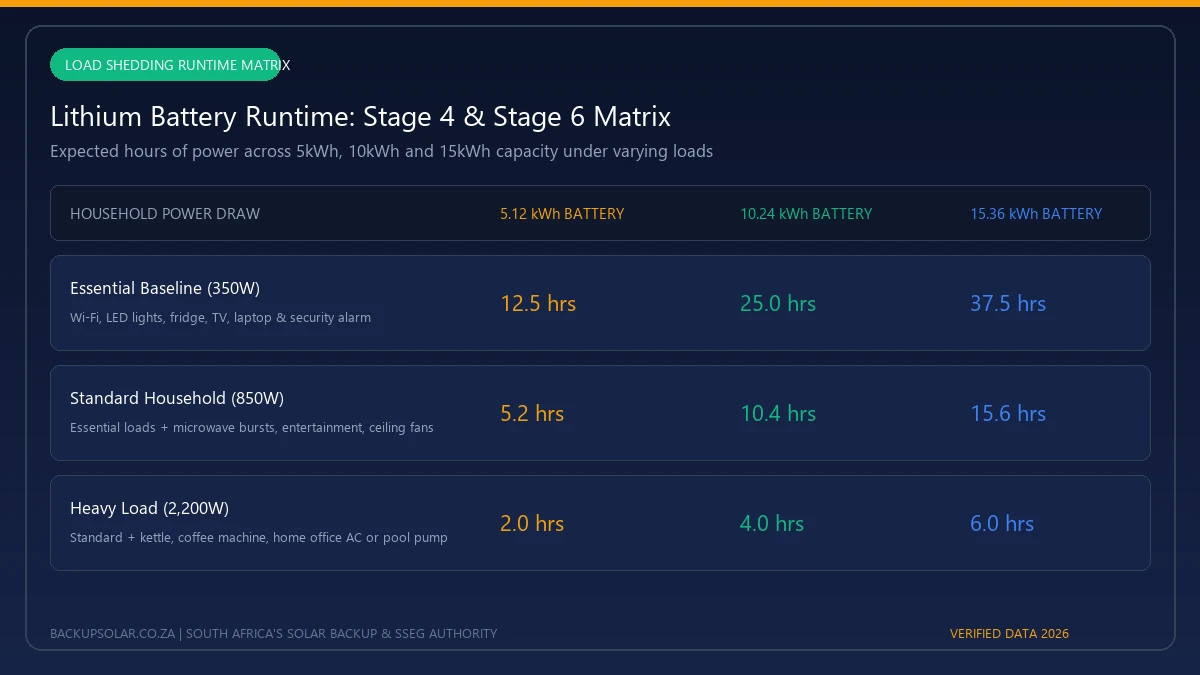
Comprehensive Battery Runtime Matrix (5.12kWh vs 10.24kWh vs 15.36kWh)
| Household Scenario | Avg. Power Draw | 1x 5.12kWh Battery (4.6kWh Usable) | 2x 5.12kWh Battery (9.2kWh Usable) | 3x 5.12kWh Battery (13.8kWh Usable) |
|---|---|---|---|---|
| Essential Baseline LED lights, Wi-Fi router, TV, 1x fridge, alarm |
350 Watts | 12.5 Hours Outlasts any stage |
25.0 Hours Full 24h autonomy |
37.5 Hours Multi-day backup |
| Standard Household Essential + 2 TVs, laptops, fans, freezer, fridge |
850 Watts | 5.2 Hours Clears Stage 6 (4.5h) |
10.4 Hours Full evening ease |
15.6 Hours All-day power |
| Heavy Comfort Standard + microwave bursts, kettle, 1x AC |
1,500 Watts | 2.9 Hours Risk on 4.5h slot |
5.9 Hours Clears Stage 6 slot |
8.8 Hours Whole-house comfort |
| Whole-Estate Load Full appliances, pool pump, climate control |
2,500 Watts | 1.7 Hours Too small |
3.6 Hours Short of 4.5h slot |
5.4 Hours Clears Stage 6 slot |
Appliance Wattage Reference Guide for South African Homes
Low-Draw Essential Appliances:
- Fibre ONT & Wi-Fi Router: 15 – 25W
- LED Ceiling Downlight (per room): 8 – 12W
- 55-inch Smart TV & Decoder: 80 – 130W
- Laptop / Home Office PC: 65 – 120W
- A++ Inverter Refrigerator: 90 – 180W
- Home Alarm & CCTV Cameras: 35 – 60W
High-Draw Non-Essential Appliances:
- Electric Kettle: 1,800 – 2,200W
- Microwave Oven: 1,000 – 1,400W
- Air Fryer: 1,400 – 1,800W
- 12,000 BTU Inverter Aircon: 900 – 1,300W
- 0.75kW Pool Pump: 850 – 1,100W
- Standard Electric Geyser: 3,000 – 4,000W
Sizing Your Battery Bank & Requesting 3 Free Quotes
Tell us your essential appliances. Our engineering desk will calculate your exact required kilowatt-hours and connect you with certified local installers.
Frequently Asked Questions About Battery Runtimes & Load Shedding
Under a typical essential load of 350 Watts (Wi-Fi, LED lights, fridge, television, and home security), a 5.12kWh lithium battery with 90% Depth of Discharge delivers approximately 12.5 to 13 hours of backup power. If consumption rises to 850 Watts (adding desktop computers, ceiling fans, or kitchen appliances), runtime is approximately 5.2 hours, comfortably outlasting a standard 4.5-hour Stage 6 blackout slot.
A 10.24kWh battery bank provides 9.2kWh of usable energy. Over a 4.5-hour load shedding slot, this allows for a continuous average draw of over 2,000 Watts. You can comfortably power all home lights, multiple televisions, double-door refrigeration, home office IT gear, and run an energy-efficient microwave, air fryer, or coffee machine intermittently without depleting the battery.
Premium Lithium Iron Phosphate (LiFePO4) batteries from Freedom Won, Hubble, and Dyness are engineered for 90% to 95% Depth of Discharge (DoD). Modern Battery Management Systems (BMS) protect cells against over-discharge, ensuring 6,000+ cycles while retaining over 80% original capacity after 15 years.
An 8kW hybrid inverter connected to a 5.5kW rooftop solar array (10x 550W Tier-1 panels) will generate between 3,500W and 4,800W of DC charging power during peak midday sun. At this rate, a fully depleted 10.24kWh battery recharges from 10% to 100% in just 2.2 to 2.8 hours of clear sunlight.