Eskom Tariff Hikes 2026: Financial Impact & Solar Payback
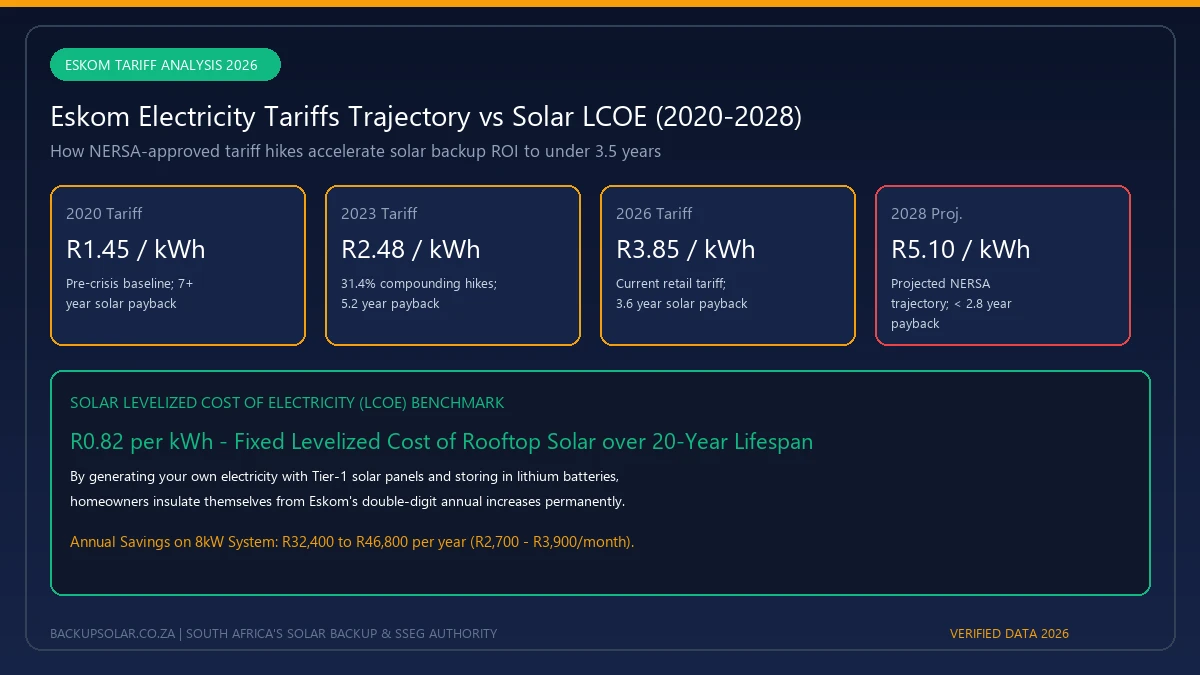
South African electricity costs have experienced an unrelenting upward trajectory over the past decade. With 2026 tariffs reaching an average of R3.85 per kWh and peak rates climbing beyond R4.60 per kWh, rooftop solar is no longer merely a load shedding backup—it is the single highest-yielding personal financial investment available to South African property owners.
Understanding the 2026 NERSA Electricity Tariff Increases
The National Energy Regulator of South Africa (NERSA) approved multi-year price determination (MYPD) adjustments designed to recover Eskom's operational expenditures, debt servicing, and emergency open-cycle gas turbine (OCGT) diesel burn. For domestic consumers in municipal distribution areas (including City Power, City of Tshwane, and eThekwini), compounding annual hikes have pushed average retail electricity prices above R3.85 per kWh.
A typical South African suburban household consuming 1,000 kWh per month now faces an Eskom electricity bill of approximately R3,850 per month (R46,200 annually)—up from R1,450/month in 2020. Projections from energy economists indicate that tariffs will cross R5.10 per kWh by 2028, accelerating the financial imperative to generate private solar energy.
Eskom Retail Tariff Restructuring & New Fixed Capacity Charges
In addition to raw tariff increases, Eskom has restructured its retail pricing structure to address the growing defection of high-volume consumers to private rooftop solar:
The Shift to Fixed Daily Network Access Fees
Historically, municipal tariffs bundled the cost of maintaining poles, transformers, and transmission wires into the variable per-kWh rate. Under the restructured framework, municipalities are introducing fixed monthly network connection fees (often R200 to R450 per month) simply for having an active grid connection, even if consumption drops.
Time-of-Use (TOU) Peak Demand Penalties
To discourage grid consumption during peak strain windows (06:00 to 09:00 and 17:00 to 20:00 on weekdays), peak electricity is charged at up to 2.8 times the standard off-peak rate. Households relying solely on the grid face punishing bills during breakfast and dinner hours.
Why Batteries Are Essential to Arbitrage Peak Tariffs
A hybrid inverter paired with a smart lithium battery allows homeowners to completely bypass peak rates. The solar array charges the battery during free midday sunlight; the battery then powers the home throughout the 17:00 to 20:00 evening peak window, eliminating expensive grid draws.
Solar Levelized Cost of Electricity (LCOE) vs Eskom Grid Tariffs
The financial return of a solar backup system is determined by comparing Eskom's grid tariffs against the Levelized Cost of Electricity (LCOE) of rooftop solar. LCOE amortizes the upfront capital equipment and installation cost over the 20-year expected lifespan of the solar array.
Every single kilowatt-hour generated by your solar panels saves you R3.03 in cold cash compared to purchasing that electricity from Eskom. Over a 20-year period, an 8kW system will generate over 260,000 kWh of clean energy, yielding well over R800,000 in avoided electricity payments.
10-Year Cumulative Savings Comparison: Eskom vs 8kW Solar
| Timeline | Eskom Bill (12% Annual Hikes) | 8kW Solar + 10kWh Battery | Cumulative Cash Savings |
|---|---|---|---|
| Year 1 | R46,200 / yr (R3,850/mo) | R6,900 / yr (R575/mo residual grid) | R39,300 |
| Year 3.5 | R61,400 / yr (R5,116/mo) | R8,800 / yr (R733/mo residual grid) | R122,000 (100% Capital Repaid) |
| Year 5 | R72,600 / yr (R6,050/mo) | R9,900 / yr (R825/mo residual grid) | R218,500 Net Profit |
| Year 10 | R127,900 / yr (R10,658/mo) | R15,800 / yr (R1,316/mo residual grid) | R682,000 Net Profit |
Calculate Your Solar Payback & Claim 3 Free Quotes
Provide your current monthly electricity spend. Our engineering software will generate an exact payback schedule and match you with accredited local installers.
Frequently Asked Questions About Eskom Tariffs & Solar ROI
For 2026, NERSA approved average electricity tariff adjustments taking standard municipal residential rates to approximately R3.85 per kWh (inclusive of VAT and municipal surcharges), with peak Time-of-Use (TOU) slots exceeding R4.60 per kWh in several urban metros.
Eskom is transitioning from purely volumetric (per-kWh) billing toward a two-part tariff structure containing fixed monthly network access charges regardless of consumption, alongside variable energy rates. This makes hybrid solar systems paired with battery storage essential to peak-shave and minimize daytime grid imports.
Once installed, rooftop solar locks in a fixed Levelized Cost of Electricity (LCOE) of approximately R0.82 per kWh over the 20 to 25 year operational lifespan of the panels. By generating and storing your own electricity, your home avoids Eskom's compounding double-digit annual tariff escalations.
At 2026 tariff levels (averaging R3.85/kWh), a properly engineered 8kW hybrid solar system with a 10kWh lithium battery achieves a full capital payback period of 3.4 to 3.9 years, generating pure tax-free electricity savings for the remaining 16+ years of system life.